
Open the visual model ↗
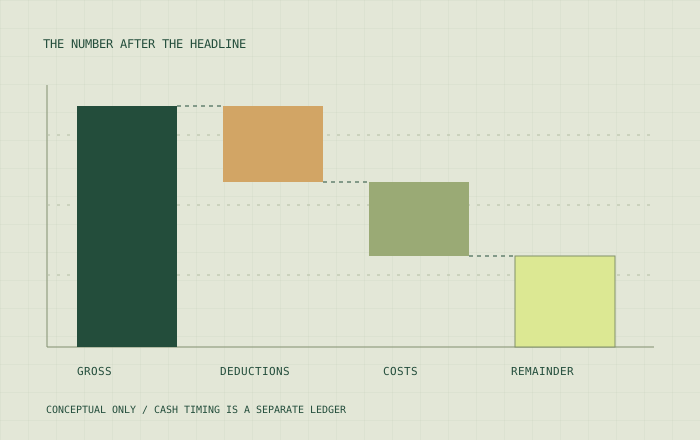
Every audience number needs a metadata block
A media kit is a compact evidence record. Describe the publication, cadence, editorial independence, and audience in plain language. List each channel separately. For every number, include its definition, source system, date range, filters, export date, and audit status. Do not add website users, email subscribers, podcast listeners, and social followers into a total audience unless overlap has actually been measured and removed.
Newsletter opens are platform events with known limitations, not a count of readers. Prefer delivered messages, unique clicks with the platform's filtering explained, unsubscribe and complaint rates, and reader research with sample size and dates. Website figures need the analytics definition and bot exclusions. Sponsor results need the product, flight, method, and an explicit statement that one campaign is not a typical outcome.
Source notes: Direct advertiser acquisition research import
Let the sponsor page be the current source
Use a dated web page as the main media kit, with an optional PDF generated from the same information. Show who the audience is, what each product includes, where it appears, the disclosure label, creative specification, count basis, price or pricing basis, open dates, and the reporting supplied. Include advertising acceptance, editorial independence, data use, cancellation, makegood, and payment summaries.
A simple inquiry form asks only what is needed to assess fit: business identity, work contact, product, target period, and enough context to route the request. It explains use and retention and does not preselect marketing consent. Sponsor links on editorial pages should carry the appropriate sponsored-link qualification. Availability remains provisional until an order is accepted; a calendar is not a silent reservation system.
Source notes: Qualify your outbound links · Native Advertising: A Guide for Businesses
Map sellable units before setting a price
For each product, forecast how many units the publication will actually produce and reserve space for editorial-only issues, house messages, holidays, and makegoods. Do not sell every theoretical slot. Then time the full pilot workflow: prospect research, calls, proposal, onboarding, creative review, trafficking, reporting, invoicing, and collections. Add tools, payment fees, representative or marketplace commissions, and any other attributable cash cost.
The cost floor must include labor at a stated loaded rate and the intended margin. A price below that floor is a documented pilot expense, not evidence that the product works. Inventory and cost change with cadence, list size, custom work, and reporting promises, so keep a versioned worksheet. The goal is not an industry-average CPM; it is a price that covers the publisher's actual delivery.
| Step | Record | Decision |
|---|---|---|
| Inventory | Produced units minus protected and reserve units | Maximum sellable units by period |
| Cost | Time, tools, processing, commissions, reporting | Per-unit cost before margin |
| Value | Buyer-stated outcome value and comparable results | Uncertain upper boundary, never assumed |
| Demand | Sell-through, qualified inquiries, win rate, renewals | Raise, hold, or repair product and fit |
| Publication | Unit, period, gross/net basis, discount rule | A rate buyers can compare and the desk can honor |
Source notes: Direct advertiser acquisition research import
Price between cost and demonstrated buyer value
Discovery may establish what an outcome is worth to the sponsor and what comparable channels have produced. Use the sponsor's figures as a range with uncertainty, leaving enough expected value with the buyer to make the test rational. If the buyer cannot share those inputs, say that the value ceiling is uncertain. A fixed fee per issue or period is often simpler for an early sponsorship than a promise tied to volatile traffic.
Publish one rate per product and period, with a clear gross or net basis. Discounts should reflect real savings, such as one onboarding process across several issues, and follow a written rule. Price exclusivity according to the inventory it removes. Itemize packages so the buyer and publisher can see each component. Review the card after a bounded number of completed campaigns using sell-through, win rate, renewal, actual hours, reader response, and collected cash.
- Never copy another publisher's CPM as proof of your own value.
- Show an implied CPM only as a comparison when the delivered denominator is defined.
- Set an end date on introductory pricing.
- Record the rate-card version on every proposal and order.
- Base renewals on campaign evidence, not manufactured scarcity.
Source notes: Standard Terms and Conditions for Internet Advertising for Media Buys One Year or Less, Version 3.0
Sources & limits
The pricing method requires the publisher's real inventory, time, cost, demand, and buyer inputs. It supplies no market benchmark, expected CPM, or tax treatment.
Adapted from supplied research. See the evidence and review method. Section source notes identify supporting references; operational suggestions remain editorial judgment.
- Direct advertiser acquisition research import
Supplied research brief · Retained in the private archive · Independent verification pending · Imported 15 September 2026 - Native Advertising: A Guide for Businesses
Regulator guidance · Publication date not stated · Primary source checked · 15 September 2026 - Qualify your outbound links
Platform documentation · Publication date not stated · Cited by supplied research; independent recheck pending · 15 September 2026 - Standard Terms and Conditions for Internet Advertising for Media Buys One Year or Less, Version 3.0
Industry standard terms · Publication date not stated · Primary source checked · 15 September 2026
Source claims and editorial judgments remain separate. Send a correction with the passage and supporting evidence.