Open the visual model ↗
Open the renewal decision before the end
A renewal review should happen while evidence, people, and future inventory are still available. Set the review date backward from the next campaign's creative deadline, buyer approval time, and the publisher's inventory-release date. The correct lead time depends on the product; the useful rule is that the review must leave enough time to fix records, form an offer, and let either side decline without an emergency.
Do not begin with “Did they like it?” Reconstruct what was actually ordered: dates, placements, audience or delivery commitments, exclusions, creative responsibilities, reporting fields, price, and any approved change. Current IAB direct-buy materials separate order-specific and optional sponsorship terms, reinforcing why the review should use the accepted order rather than memory or the latest email thread.
- Freeze the final delivery evidence before preparing the renewal narrative.
- Resolve open credits or makegoods before presenting an unqualified success claim.
- Give future inventory an explicit hold expiry; a renewal conversation is not a booking.
Review five dimensions without hiding tradeoffs
Use a review table that can contain an unfavorable answer. Delivery quality, buyer evidence, reader fit, publisher workload, and commercial contribution answer different questions. A strong click result does not excuse a disclosure incident. Clean delivery does not make an account attractive if custom reporting consumed the margin. A profitable campaign can still be a poor renewal if its claims or placement damaged reader trust.
| Dimension | Evidence to attach | Decision question | Possible response |
|---|---|---|---|
| Promise and delivery | Order, change log, frozen report | Was the agreed unit delivered? | Renew, repair, or close |
| Buyer outcome | Agreed metrics and buyer feedback | Is there evidence relevant to the stated objective? | Repeat, redesign, or avoid claim |
| Reader and editorial fit | Complaints, replies, disclosure QA | Did the placement respect the audience? | Keep, constrain, or decline |
| Work and reliability | Hours, revision count, late inputs | Can the team deliver this account predictably? | Standardize or reprice |
| Contribution | Revenue, direct cash costs, delivery labor | Did the package earn enough for its load? | Renew, resize, or release |
Reprice from the next delivery load
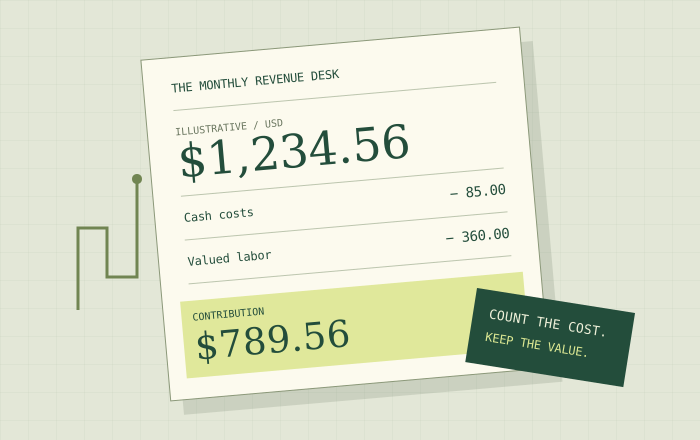
The following arithmetic is hypothetical. A $3,200 campaign took 18 delivery hours valued internally at $60 per hour and $300 of direct cash cost. Its operating contribution was $1,820: $3,200 − $1,080 − $300. The buyer now wants six additional reporting hours at the same price. If everything else stays equal, contribution becomes $1,460 because delivery labor rises to $1,440.
That $360 reduction is visible before a quote is sent. The publisher could remove the custom report, charge for it, narrow another deliverable, or decline. Do not use a score to automate this decision. The worksheet exists to expose what the renewal would consume and what must be true for the offer to work.
| Line | Completed campaign | Requested renewal | Change |
|---|---|---|---|
| Price | $3,200 | $3,200 | $0 |
| Delivery labor | 18 h × $60 = $1,080 | 24 h × $60 = $1,440 | +$360 cost |
| Direct cash costs | $300 | $300 | $0 |
| Operating contribution | $1,820 | $1,460 | −$360 |
End with one explicit disposition
Record one of five outcomes: renew unchanged, renew with a revised scope or price, offer a limited test, release the inventory, or decline the account. Name the owner, buyer decision date, inventory-hold expiry, and next creative deadline. If the publisher owes a correction, credit, or makegood, keep that item visible instead of burying it in a new order.
After the conversation, store the buyer's stated reason separately from the publisher's interpretation. “Budget moved to Q2” is different from “price objection.” A nonrenewal is still useful evidence when categorized consistently. Across campaigns, the ledger can show which packages renew with manageable labor and which depend on unpriced customization. That is a portfolio input, not proof that any single sponsor will behave the same way next time.
Continue the work
Sources & limits
The review is an editorial operating method, not a prediction of renewal and not contract advice. The parties' signed terms control obligations and remedies.
- Standard Advertising Services Terms & Conditions – New Terms as of May 2026
Primary source · Source published 20 May 2026 · Primary source checked · 19 September 2026
Source claims and editorial judgments remain separate. Send a correction with the passage and supporting evidence.