
Open the visual model ↗
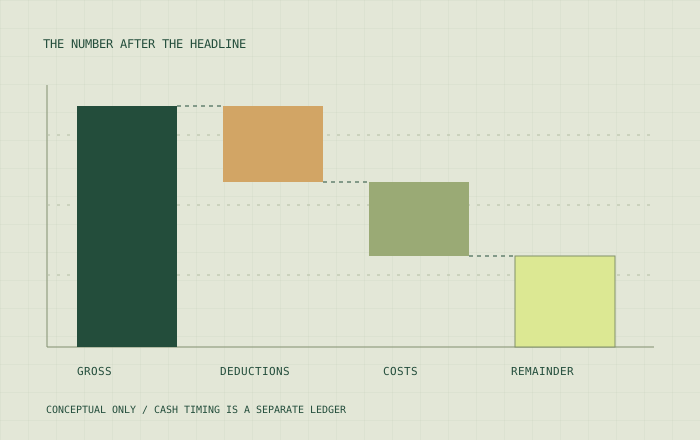
Give each commercial event its own record
An order, a delivery report, an invoice, a credit, a payment, and a bank deposit are related events, not interchangeable documents. Reconciliation links them with stable identifiers and explains every difference. The invoice ledger should therefore contain order ID, advertiser or customer, invoice number, issue and due dates, original amount, credits, amount due, payment status, payment reference, deposit batch, and exception owner.
A processor's status can help, but it does not replace the publisher's commercial record. Stripe's current Invoice object, for example, exposes amount due, paid, and remaining; invoice status can be draft, open, paid, uncollectible, or void, and credit-note amounts are represented separately. Use the fields that exist in the chosen system, then map them into a platform-neutral ledger that remains readable after a tool change.
- Freeze the delivered unit or accepted milestone before billing it.
- Never overwrite an original amount to make a credit disappear; link the adjustment.
- Store processor or bank references, not screenshots as the only proof of payment.
Reconcile in four directions
First match invoice to order: customer, currency, agreed price, billable milestone, and purchase-order reference where required. Then match adjustments: each credit or corrected invoice needs a reason and approver. Third, match payment to the open amount using the payment reference and received date. Finally, match the payment to a bank deposit or processor payout, which may combine transactions and subtract fees.
Do not force a match merely because two totals are equal. A shared payment reference, remittance note, customer identity, and plausible date create stronger evidence. Leave uncertain cash in an exception queue until a person resolves it. The aim is a traceable bridge, not a tidy status column.
| Link | Compare | Common exception | Resolution evidence |
|---|---|---|---|
| Order → invoice | Unit, price, currency, milestone | Custom item omitted | Accepted order or change record |
| Invoice → credit | Original amount and adjustment | Credit netted silently | Credit ID, reason, approval |
| Open amount → payment | Amount, payer, reference, date | Partial or combined payment | Remittance and payment ID |
| Payment → bank | Payout batch and net deposit | Fees or multiple payments | Processor payout detail |
Work a complete example
The following example is hypothetical. Order SO-184 authorizes a $4,800 sponsor package. A documented delivery miss creates credit CN-31 for $600, leaving $4,200 due. The customer pays $4,200 under payment reference PAY-882. The publisher's processor includes that payment in a $9,850 net bank deposit with other receipts and fees, so the bank line alone cannot prove which invoice was paid.
The ledger reconciles the commercial balance first: $4,800 − $600 − $4,200 = $0 remaining. It then links PAY-882 to the payout detail that produced the combined deposit. The $600 is not described as cash received and the $9,850 is not assigned wholly to this invoice. If the payment were $4,000, the invoice would remain $200 open unless another authorized adjustment existed.
| Event | Reference | Debit/open effect | Credit/settlement effect | Running open amount |
|---|---|---|---|---|
| Invoice issued | INV-204 | +$4,800 | — | $4,800 |
| Credit approved | CN-31 | — | $600 | $4,200 |
| Payment received | PAY-882 | — | $4,200 | $0 |
| Bank payout matched | PO-517 | No invoice effect | Evidence link | $0 |
Close periods with an exception queue
At a regular close, list open invoices by age, unapplied receipts, credits without approval, paid invoices lacking bank matches, and deposits lacking payout detail. Assign each exception an owner and next date. Status labels should describe facts: “payment promised” is still open; “sent to buyer” is not received; “void” is not paid.
Preserve the record when correcting it. Add the credit, replacement invoice, or explanatory note rather than deleting the trail. Reconcile operationally at the invoice level even if an external bookkeeper maintains the formal accounts. The clean handoff is a ledger with stable IDs, attached evidence, and unresolved items clearly marked. Ask the responsible accounting or tax adviser how those items should appear in formal books and filings.
Continue the work
Sources & limits
This is an editorial cash-control framework, not accounting, tax, collections, or legal advice. Bookkeeping treatment, invoice requirements, and retention rules depend on jurisdiction and the publisher's advisers.
- The Invoice object
Primary source · Publication date not stated · Primary source checked · 19 September 2026
Source claims and editorial judgments remain separate. Send a correction with the passage and supporting evidence.