Open the visual model ↗
Begin with the order, not the dashboard
Create one row for every promised unit: placement, format, flight, quantity or fixed duration, targeting, creative version, disclosure, measurement owner, reporting window, and remedy. A newsletter placement promised in three issues is different from 60,000 guaranteed impressions; a fixed homepage presence is different from either. Do not translate a duration promise into an impression guarantee after the sale.
Attach the signed order or approved campaign brief and version every later change. Standard industry terms can provide a checklist for delivery, reporting, cancellation, and makegoods, but sponsorships and direct deals may need terms written for their actual product. The scorecard records the parties' agreement; it should not silently import a platform's default definition.
| Unit | Promise | Observed delivery | Status |
|---|---|---|---|
| Newsletter A | 3 issues | 3 sent | Delivered |
| Homepage | 14 days | 13 days 6 hours | Review shortfall |
| Display | 50,000 rendered impressions | 51,240 | Delivered |
| Report | Within 7 business days | Day 6 | Delivered |
Invented values; remedies depend on the actual agreement.
Source notes: Standard Terms and Conditions for Internet Advertising for Media Buys One Year or Less, version 3.0
Put the method beside every result
For each metric, show the event, numerator, denominator, system, time zone, filters, and data freeze. Rendered impressions, measurable impressions, viewable impressions, clicks, landing sessions, and advertiser conversions belong on separate rows. If the sponsor supplies outcomes, label them advertiser-reported and include the attribution window and model if provided. Do not add publisher and advertiser counts into a combined total.
Use the contracted measure for delivery status and other measures for diagnosis. The MRC impression guidance supports clear distinctions among tracked ads, impressions, and later metrics, while viewability has its own eligibility rules. A publisher's first-party report can document its observation point but does not become independent accreditation. State the limitation once, near the table, in plain language.
Source notes: Desktop Display Impression Measurement Guidelines, version 1.1 · Viewable Ad Impression Measurement Guidelines, version 2.0
Read an outcome without claiming causation
Illustrative campaign: a sponsor buys two newsletter placements and 50,000 rendered display impressions. The publisher delivers both sends and 51,240 renders. Of 46,000 measurable display impressions, 30,820 meet the agreed viewability rule. The publisher records 612 signed outbound clicks. The advertiser reports 470 landing sessions and 31 trial starts under its seven-day last-click model. Each figure is useful and each answers a different question.
The report may say the campaign delivered 102.5% of its rendered-impression promise and that the advertiser reported 31 attributed trials. It should not say the publisher caused 31 customers or calculate return on investment without the sponsor's verified revenue and cost basis. The 142-event gap between outbound clicks and landing sessions prompts a reconciliation note about systems, latency, consent, and filtering; it is not automatically loss or fraud.
| Layer | Result | Status or interpretation |
|---|---|---|
| Promised display | 50,000 renders | Contract basis |
| Delivered display | 51,240 renders | 102.5% delivered |
| Viewability | 30,820 / 46,000 measurable | 67.0%; diagnostic |
| Outbound clicks | 612 publisher-observed | Publisher method |
| Landing sessions | 470 advertiser-reported | Separate system |
| Trial starts | 31 advertiser-reported | Attributed, not proven causal |
All campaign values are hypothetical.
Source notes: Viewable Ad Impression Measurement Guidelines, version 2.0
Record reader and operations signals
Add creative approvals, complaints, corrections, blocked categories, accessibility issues, site-performance incidents, and sponsor-service hours. These do not belong in a blended success score. One complaint can reveal a serious disclosure problem; fifty neutral messages do not cancel it. Include the sponsor's objective review and the publisher's editorial-trust review as distinct judgments with named owners.
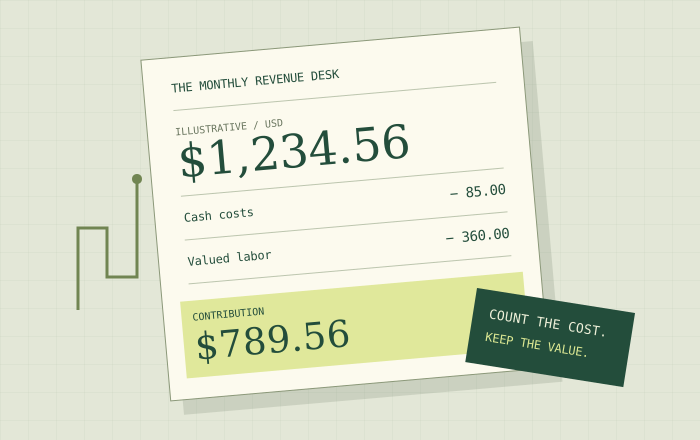
Show commercial contribution separately from gross billings. An illustrative $6,000 campaign with $900 in sales and fulfillment labor, $250 in creative production, and $150 in makegood inventory has $4,700 before broader overhead and tax. That arithmetic does not value the publisher's audience or prove the campaign should renew. It makes the internal operating cost visible for the next price decision.
Source notes: Standard Terms and Conditions for Internet Advertising for Media Buys One Year or Less, version 3.0
Close with actions for both sides
End the scorecard with delivery accepted or disputed, invoice basis, remaining discrepancy, remedy, asset disposition, and renewal recommendation. The renewal recommendation should cite evidence: keep the product, change the creative deadline, reduce a fragile placement, separate newsletter and display reporting, or decline a category. A sponsor's satisfaction is relevant, but it cannot erase a reader-trust or production problem.
Freeze the report used for invoicing and issue later corrections as numbered versions. Give the sponsor enough event definitions to reproduce the commercial arithmetic without exposing reader-level data. Retain data only for the stated purpose and period. A compact scorecard earns its place when it makes the next campaign easier to sell honestly, deliver reliably, and evaluate without unsupported attribution.
- Reconcile every promised unit before discussing outcomes.
- Label publisher and advertiser observations by system.
- Keep viewability and clicks out of the causal-outcome column.
- Show direct fulfillment cost without presenting contribution as profit.
- Version the report that supports the invoice.
Source notes: Standard Terms and Conditions for Internet Advertising for Media Buys One Year or Less, version 3.0 · Desktop Display Impression Measurement Guidelines, version 1.1
Continue the work
Sources & limits
The scorecard and examples are editorial templates, not standard contract terms, accredited measurement, accounting advice, or evidence of campaign performance. Actual orders must define their own measures and remedies.
- Standard Terms and Conditions for Internet Advertising for Media Buys One Year or Less, version 3.0
IAB and 4A's standard terms · Publication date not stated · Primary source checked · 19 September 2026 - Desktop Display Impression Measurement Guidelines, version 1.1
MRC measurement guideline · Publication date not stated · Primary source checked · 19 September 2026 - Viewable Ad Impression Measurement Guidelines, version 2.0
MRC measurement guideline · Publication date not stated · Primary source checked · 19 September 2026
Source claims and editorial judgments remain separate. Send a correction with the passage and supporting evidence.