
Open the visual model ↗
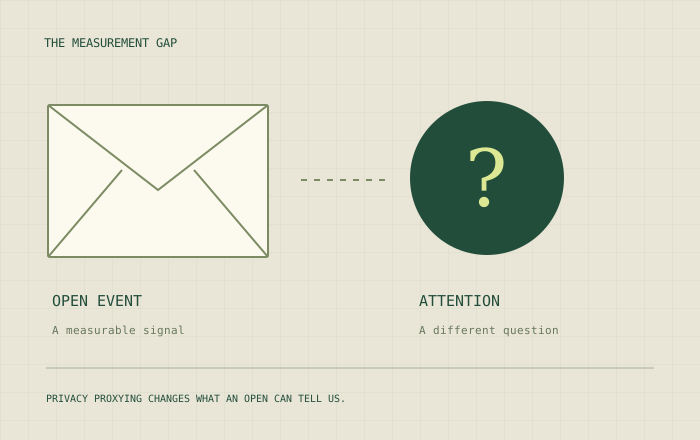
One ad creates several different events
An ad request, a decision, a render, a viewable impression, a click, a landing-page visit, and a conversion are separate observations. They occur in different systems and each can fail before the next one happens. A server can record that it returned an image even when the reader closes the page before the image loads. Browser code can record a render while the slot remains below the viewport. A redirect can record a click even when the advertiser's landing page fails. None of those observations proves a person paid attention.
Build reports from this ladder rather than from the label a dashboard happens to use. Give every event a stable identifier created when the placement decision is made. Record later events against that identifier, and leave missing steps missing. If a click arrives without a render beacon, report the click and flag the absent render; do not manufacture an impression to make the sequence look tidy. Conversion figures belong to the advertiser unless the publisher operates the destination, and attribution remains an interpretation even when the conversion itself is real.
| Rung | Observation | Does not establish |
|---|---|---|
| Request | A page or script asked for a placement | That an ad was returned or a person was present |
| Decision | The deciding system selected and returned an ad | That the browser loaded it |
| Render | The creative loaded and began to paint | That it entered the viewport |
| Viewable | The measured geometry met the agreed time and pixel rule | That a person noticed it |
| Click | The click handler or redirect fired | That the landing page loaded or the click was intentional |
| Conversion | The advertiser recorded its chosen outcome | That the ad caused the outcome |
The measurer, filter set, time zone, and methodology version should accompany every rung.
Source notes: Mobile Viewable Impression Measurement Guidelines
The denominator changes the story
A ratio is incomplete until its denominator is named. Viewability is normally viewable impressions divided by measurable impressions, not all requests. Click-through rate may use rendered impressions, returned ads, or viewable impressions; each produces a different result. Fill rate may mean returned ads divided by requests, while a partner may first remove requests it considers ineligible. Match rate can describe auction responses in one report and recognized users in another. Treat the label as a prompt to inspect the formula, not as a shared definition.
The commercial ratios need the same discipline. CPM is cost or revenue divided by the agreed impression count, multiplied by one thousand. Effective CPM applies that arithmetic to revenue regardless of the original pricing model. Page RPM uses page views; revenue per session uses sessions, whose boundaries must be defined. Gross revenue is what the buyer pays, while net revenue is what the publisher receives after named fees and shares. A rate card, campaign order, report, and invoice should all use the same basis.
- Write the formula beside every rate, including the exact numerator and denominator.
- State whether invalid events were removed before or after the denominator was formed.
- Keep gross buyer spend separate from publisher net revenue.
- Never present viewability as attention or advertiser-reported conversions as publisher-verified outcomes.
Source notes: Mobile Viewable Impression Measurement Guidelines · Standard Terms and Conditions for Internet Advertising for Media Buys One Year or Less, Version 3.0
Investigate discrepancies by moving down the ladder
Two systems can disagree without either one being fraudulent. They may count at different rungs, close the reporting day in different time zones, use different bot filters, or lose events to blockers, timeouts, caching, navigation, and redirects. Start reconciliation with definitions and timestamps. Compare requests, returned ads, renders, measured impressions, viewable impressions, and clicks in that order. The first rung where the counts diverge usually narrows the cause.
Invalid traffic deserves its own record. Routine filtering can remove known crawlers, missing or implausible user agents, prefetches, duplicates, and impossible bursts. Those controls do not detect sophisticated schemes that require broad behavioral data and specialist review. Publishers should describe exactly what they filter and avoid calling a basic bot list fraud detection. For high-stakes or independently verified buys, use a qualified measurement provider and preserve both raw counts and the exclusions applied.
| Check | Question | Evidence to retain |
|---|---|---|
| Definition | Did both parties count the same rung? | Contract definition and methodology version |
| Window | Do dates, time zones, and late-event cutoffs match? | Export settings and freeze time |
| Filtering | Which bots, duplicates, and test events were removed? | Reason-coded exclusion counts |
| Delivery path | Did tags, redirects, or assets fail to load? | Error, timeout, and HTTP status logs |
| Resolution | Which measure controls billing and what remedy applies? | Written reconciliation and report revision |
Source notes: Standard Terms and Conditions for Internet Advertising for Media Buys One Year or Less, Version 3.0 · IAB/ABC International Spiders & Bots List
Freeze reports without hiding corrections
A useful campaign report shows delivery by line item and day, the event rung for every column, invalid events removed by reason, progress against the contracted goal, and the pricing calculation. It also states the measuring system, time zone, filters, late-event window, and methodology version. When sponsor and publisher systems disagree, include both values and the reconciliation status rather than silently selecting the more favorable one.
Once a report supports an invoice, freeze it. A later correction should create a new version with the reason, author, time, and changed fields. This makes ordinary late events distinguishable from unexplained edits. The same practice protects readers and advertisers: it turns a dashboard number into an auditable commercial record while keeping the measurement limits visible.
Source notes: Standard Terms and Conditions for Internet Advertising for Media Buys One Year or Less, Version 3.0
Sources & limits
This guide explains measurement structure, not accredited measurement. Bot filters and contractual remedies vary, so a campaign must name its own controlling measure and current terms.
Adapted from supplied research. See the evidence and review method. Section source notes identify supporting references; operational suggestions remain editorial judgment.
- Mobile Viewable Impression Measurement Guidelines
Measurement standard · Publication date not stated · Primary source checked · 15 September 2026 - Standard Terms and Conditions for Internet Advertising for Media Buys One Year or Less, Version 3.0
Industry standard terms · Publication date not stated · Primary source checked · 15 September 2026 - IAB/ABC International Spiders & Bots List
Industry resource · Publication date not stated · Cited by supplied research; independent recheck pending · 15 September 2026
Source claims and editorial judgments remain separate. Send a correction with the passage and supporting evidence.