
Open the visual model ↗
Give each line a boundary
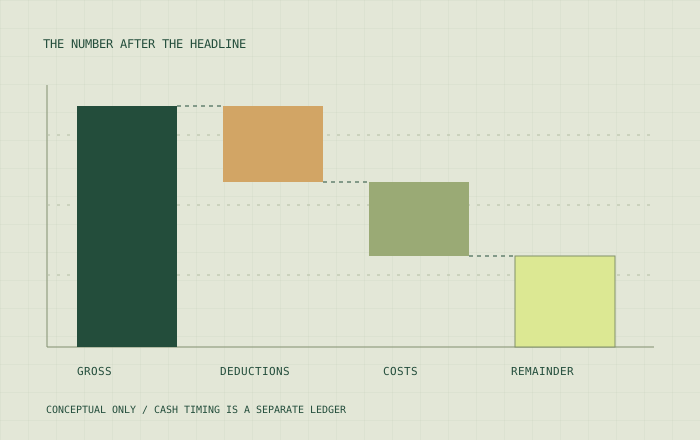
Gross revenue is the customer or platform amount before network shares, refunds, payment fees, sales commissions, and direct fulfilment costs. Net revenue needs an explicit definition; here it means gross minus those deductions, before internal labor and overhead. Contribution is net revenue minus incremental cash fulfilment costs and valued incremental labor. It is not accounting profit.
Those distinctions matter because a payment can arrive before the work is delivered, a commission can remain pending validation, and a platform can pay after the earning month. A ledger that collapses every stage into one revenue number hides the decisions a small publisher needs to make.
Cash can be larger than the month’s earned value
Consider an illustrative annual tool license: 75 customers pay $120 upfront, so $9,000 in cash arrives. If access is delivered across twelve months, a simple management view might allocate $750 to the first month and leave $8,250 as future delivery obligation. Neither amount is a claim about formal accounting treatment; it is a reminder that the publisher still owes access and support.
If the same month also sells a $6,000 research package, subtracts $1,600 of contractor cost, $292.50 of invented processing cost, $180 of hosting, and values 53 internal hours at $3,000, cash movement and contribution will tell different stories. Cash before tax and valued internal labor can look healthy while the operating model is far tighter.
Keep the states separate
For each offer, retain booked, delivered, invoiced, approved where relevant, collected, gross, deductions, net, incremental cash cost, and valued labor. Add the unit, period, currency, geography when known, payment terms, refund exposure, and any unfulfilled obligation. This also makes it possible to see concentration by counterparty, platform, channel, and stream.
The practical judgment is simple: never call a headline revenue number a business result until its deductions, labor, and cash timing are visible. That discipline will not make a model profitable, but it will make an uneconomic promise easier to stop before it becomes a habit.
- Do not substitute collected cash for delivered value.
- Do not call net revenue profit without defining overhead and labor treatment.
- Do not treat a pending affiliate commission as collected cash.
Sources & limits
The example uses invented processing, cost, and labor assumptions and is a management illustration, not accounting, tax, or financial advice.
- Payment timelines for AdSense
First-party product documentation · Publication date not stated · Referenced in the earlier research pass · 15 September 2026 - When will I receive payment?
Affiliate-network documentation · Source published 19 June 2020 · Referenced in the earlier research pass · 15 September 2026 - Pricing & Fees
Vendor pricing page · Publication date not stated · Referenced in the earlier research pass · 15 September 2026
Source claims and editorial judgments remain separate. Send a correction with the passage and supporting evidence.