
Open the visual model ↗
Freeze the period and define every status
Open the close with the reporting period, time zone, currency, entities, channels, and cutoff timestamp. Preserve source exports before dashboards roll forward. Define delivered, estimated, finalized, invoiced, approved, paid, refunded, adjusted, and disputed. These are different states. A single revenue total without its state and source cannot be reconciled.
Vendor documentation illustrates the distinction. AdSense separates estimated activity from finalized earnings and notes that reporting boundaries can differ. Google Ad Manager also documents adjustments in Programmatic Direct reporting. These are vendor-specific mechanics, but the operating lesson generalizes: keep original delivery, later adjustments, payment entitlement, and cash receipt in separate fields. The publication's accounting treatment belongs to its accountant and books.
| Field | Illustrative entry | Evidence |
|---|---|---|
| Period/time zone | August, publisher ledger zone | Close calendar |
| Currency | USD | Contract/report |
| Snapshot cutoff | 2026-09-03 17:00 | Saved export |
| Status vocabulary | Estimated/final/invoiced/paid | Data dictionary |
The date is hypothetical, not a claimed reporting deadline.
Source notes: Difference between estimated and finalized earnings · Programmatic Direct payments and reports
Reconcile each channel from obligation to cash
For direct sponsorship, match signed order, promised units, publisher delivery, accepted makegoods, invoice, and receipt. For programmatic, match eligible period, vendor finalized report, adjustments, payment statement, and deposit. For newsletters, affiliate programs, subscriptions, donations, and events, create equally explicit ladders. Preserve identifiers such as order, campaign, invoice, statement, payout, and bank reference so the join can be repeated.
Do not force unlike channels into one denominator. Sponsorship may close against contracted units, subscriptions against successful charges net of refunds, and affiliate revenue against approved commissions. The common structure is a state transition with evidence. A material unmatched amount becomes a named reconciling item with owner and next action, not a silent plug.
- Save source reports and contract versions.
- Match stable identifiers across systems.
- Separate quantity, rate, fees, tax, adjustments, and currency conversion.
- Record disputes and expected resolution dates.
- Link cash receipts without overwriting the delivery record.
Explain the bridge with hypothetical arithmetic
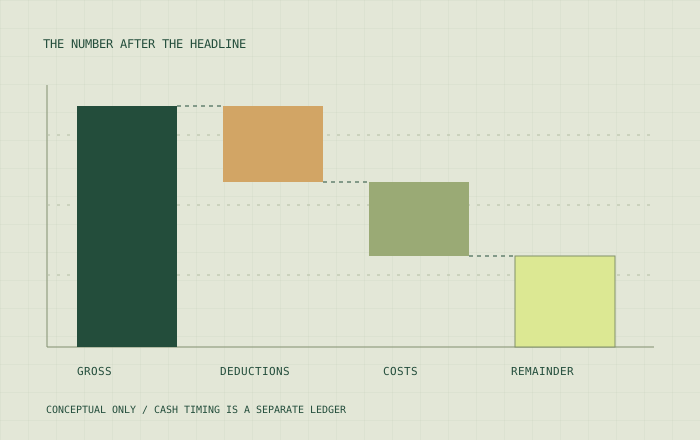
Suppose a programmatic dashboard showed $12,400 estimated for the period. A finalized statement shows $12,250 after a $150 adjustment. The payment statement includes $12,250, but only $10,000 reaches the bank before the publisher's close cutoff; $2,250 remains in the payment pipeline. The operational bridge is $12,400 estimated, minus $150 adjustment, equals $12,250 finalized; $10,000 received plus $2,250 pending equals the same finalized amount.
That bridge does not decide when revenue is recognized, whether an amount is taxable, or how foreign exchange is booked. It shows why a dashboard, statement, and bank balance can all be accurate for different states. Attach the vendor's explanation for adjustments and payment timing, then route accounting questions to the appropriate professional.
| Step | Amount | Status |
|---|---|---|
| Dashboard estimate | $12,400 | Estimated |
| Final adjustment | −$150 | Documented difference |
| Finalized amount | $12,250 | Vendor-final |
| Cash received by cutoff | $10,000 | Bank-matched |
| Payment pipeline | $2,250 | Pending |
Hypothetical arithmetic; it is not accounting guidance.
Source notes: Difference between estimated and finalized earnings
Sign off exceptions and carry forward open items
End with a close sheet listing every source received, every missing report, reconciled totals by status, material variances, disputes, expected payments, and owners. Apply a documented materiality threshold approved by the business; do not invent one from this guide. Lock the working snapshot, preserve formulas or query versions, and carry open items into the next period with their original identifiers.
Review recurring differences quarterly. A persistent time-zone mismatch, net-versus-gross confusion, or campaign naming failure should become a systems fix. The close is complete operationally when every scoped amount is reconciled or explicitly open, evidence is retained, and an authorized reviewer signs the checklist. It is not a substitute for the general ledger, financial statements, tax work, or professional accounting judgment.
Source notes: Programmatic Direct payments and reports
Continue the work
Sources & limits
This is an operational reconciliation method, not accounting, tax, or audit advice. Use the publication's books and qualified professionals for formal treatment.
- Difference between estimated and finalized earnings
Google AdSense documentation · Publication date not stated · Primary source checked · 19 September 2026 - Programmatic Direct payments and reports
Google Ad Manager documentation · Publication date not stated · Primary source checked · 19 September 2026
Source claims and editorial judgments remain separate. Send a correction with the passage and supporting evidence.