
Open the visual model ↗
Name the exchange before choosing the platform
A subscription generally sells continuing access to content or utility. A membership can add belonging, participation, status, or mission. A donation asks for support without promising an equivalent commercial benefit, although tax treatment depends on entity and jurisdiction. Patronage can combine access and support. The labels are not interchangeable: they shape reader expectations, cancellation, benefits, accounting, and the claims a publisher can make.
Write a one-sentence promise that a reader can test. Examples include access to a database, a weekly specialist briefing, participation in a moderated community, or support for reporting that remains public. Then list the delivery cadence, response time, archives, portability, cancellation path, refund approach, and what happens if publication pauses. A vague appeal to support quality may attract early goodwill but gives the team little basis for retention decisions.
| Form | Primary promise | Core measure | Common hidden work |
|---|---|---|---|
| Subscription | Continuing access or utility | Active paid subscriptions, churn, renewal | Billing failures, access, cancellation, refunds |
| Membership | Access plus belonging or participation | Active members, benefit use, renewal | Community moderation and benefit fulfillment |
| Donation | Support for a mission or output | Donors, repeat gifts, unrestricted cash | Receipts, restrictions, tax and nonprofit claims |
| Patronage | Support plus selected benefits | Active patrons, tier mix, retention | Tier complexity and platform dependence |
Source notes: Publisher revenue evidence map, September 2026 · Full map of publisher monetization methods
Count people, subscriptions, fees, and service cost
Monthly recurring revenue is price times active monthly subscriptions, but annual plans, discounts, gifts, refunds, failed payments, taxes, and currency conversion complicate the total. Keep paying people separate from paid subscriptions because one person can hold or gift more than one. Use beginning members, additions, cancellations, reactivations, and ending members to explain movement rather than reporting only a growth percentage.
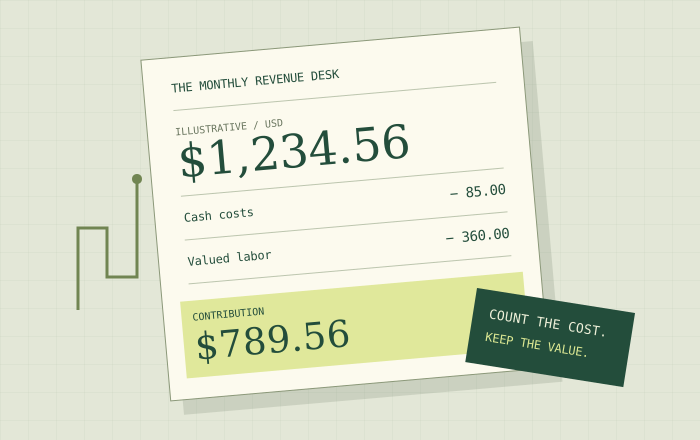
Contribution subtracts platform charges, processing, recurring-billing fees, support, benefit fulfillment, and valued editorial or community labor. Annual cash paid upfront improves liquidity while creating a future service obligation. Monthly plans expose churn faster and incur more payment events. Compare the platform using a range of plausible member counts and prices, and include the fixed hosting plan as well as percentage fees.
Source notes: How much does Substack cost? · Are there any transaction fees?
Retention is an editorial signal
Acquisition asks why someone first pays; retention asks whether the publication keeps its promise. Track voluntary cancellation, payment failure, refund requests, benefit use, support themes, and cohort renewal. Ask departing readers for an optional reason without creating friction in cancellation. A high conversion launch followed by rapid cancellation can indicate promotional demand rather than durable product fit.
Do not force every useful article behind a paywall by default. A publication may use public work for discovery and trust while reserving depth, tools, archives, community, or service for members. The appropriate boundary depends on mission and acquisition economics. Explain it plainly so non-paying readers understand what remains available and paying readers understand what their money sustains.
Source notes: Publisher revenue evidence map, September 2026 · Full map of publisher monetization methods
Test willingness and delivery together
Before building many tiers, interview current readers and offer one simple paid promise. Set a minimum viable cohort, a delivery period, a price, and a refund rule. Record the time to create the benefit and support each member. A founding offer can test demand, but do not call scarcity or a deadline real unless it is real. Do not interpret survey interest as payment behavior.
After the pilot, compare collected cash, delivery cost, retention signals, reader feedback, and the effect on free audience growth. Continue if members use and renew the benefit and the team can deliver it without degrading the core publication. Revise the promise when acquisition is healthy but benefit use is low. Stop or refund when the publication cannot meet the stated cadence or when support and fulfillment overwhelm the contribution. Preserve each cohort's offer and price so a later renewal comparison is not distorted by changed benefits.
- Use one plain promise and few tiers.
- Keep subscriptions, paying people, and cash separate.
- Model annual service obligations and monthly payment failures.
- Make cancellation understandable and operationally tested.
Sources & limits
The supplied willingness-to-pay evidence is weighted toward news and should not be generalized to every niche. Tax, nonprofit, cancellation, and auto-renewal obligations require jurisdiction-specific review.
Adapted from supplied research. See the evidence and review method. Section source notes identify supporting references; operational suggestions remain editorial judgment.
- How much does Substack cost?
First-party product documentation · Source updated 16 December 2025 · Primary source checked · 15 September 2026 - Are there any transaction fees?
First-party product documentation · Publication date not stated · Primary source checked · 15 September 2026 - Publisher revenue evidence map, September 2026
Supplied research brief · Retained in the private archive · Independent verification pending · Imported 15 September 2026 - Full map of publisher monetization methods
Supplied research brief · Retained in the private archive · Independent verification pending · Imported 15 September 2026
Source claims and editorial judgments remain separate. Send a correction with the passage and supporting evidence.