
Open the visual model ↗
Newsletter revenue has several buyers and units
A sponsor may buy one issue, a run of issues, a dedicated send, a category exclusivity, or a fixed share of the available placements. A marketplace may insert campaigns and retain a share. An affiliate merchant pays for validated outcomes. Readers may pay monthly or annually for access, community, or support. These are different products with different risk, so a rate card should name the placement, audience, delivery basis, exclusions, reporting, cancellation terms, and remedy.
Fixed fees are easy to understand and shift delivery risk according to the contract. A newsletter CPM usually means price per thousand delivered emails, but some sellers use subscribers, opens, or another base; write the denominator into the order. Cost per click and cost per acquisition move more performance risk to the publisher. A dedicated send consumes more audience attention and should not be treated as a larger version of a small in-issue placement.
| Offer | Pricing basis | Main operating question |
|---|---|---|
| Issue sponsor | Flat fee or delivered-email CPM | What exactly is delivered and reported? |
| Dedicated send | Flat fee, CPM, or hybrid | Who approves copy, targeting, suppression, and timing? |
| Marketplace ad | Platform-defined share or payout | Who controls eligibility, targeting, and advertiser quality? |
| Affiliate placement | Validated sale, lead, or bounty | What attribution window, reversals, and payment lag apply? |
| Paid tier | Recurring or annual reader price | What ongoing value, support, churn, tax, and refund burden follows? |
Source notes: Research brief 01 · Publisher revenue evidence map, September 2026
Report what the instrument can support
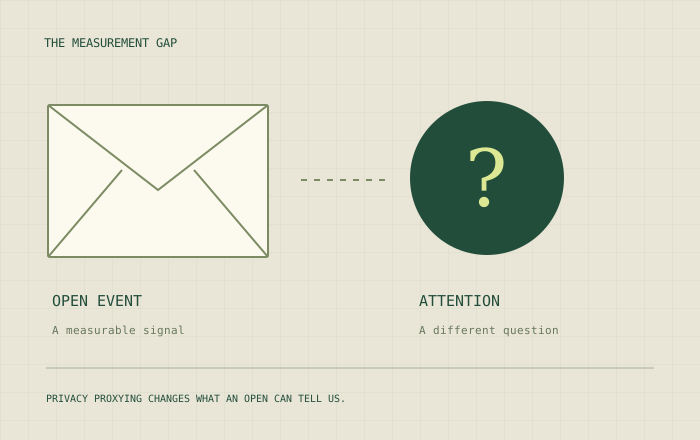
Delivered mail is not the same as human attention. Opens are especially difficult to interpret because privacy features and automated retrieval can load tracking pixels without a person reading. Clicks are closer to observable action but still include scanners and do not prove a purchase. A sponsor report should show delivered count, bounce and suppression treatment, clicks under a stated method, landing-page outcomes when available, complaints, and the measurement limitations.
Renewal is often a more useful commercial signal than a single campaign's open rate. Record whether the sponsor returned, expanded, paused, or objected; record actual sales and service hours; and ask which audience attribute mattered. A small specialist list can be valuable because of relevance and trust, while a larger general list can underperform. No public universal sponsorship rate was established in the supplied research, so publishers should build a price from their own audience, inventory scarcity, production work, and tested demand.
Source notes: Research brief 01 · Publisher revenue evidence map, September 2026
Paid subscriptions change the obligation
A paid tier creates recurring revenue but also recurring work: billing support, cancellations, refunds, retention, tax handling, and a durable editorial promise. Platform fee comparisons must include the publishing plan, platform transaction share, payment processing, recurring-billing fee, currency conversion, failed payments, and migration cost. Checked on 15 September 2026, Substack's support page says it takes 10% of each paid transaction and lists Stripe card processing plus a 0.7% recurring Billing fee. Ghost says it takes no transaction fee, while Stripe processing and the Ghost hosting plan remain costs.
Those facts do not identify a universal winner. A platform that takes a percentage can bundle discovery and operating convenience; self-hosting can reduce the transaction share while increasing fixed cost and responsibility. Model monthly and annual plans separately, include refunds and churn, and compare cash received rather than multiplying the end-of-year member count by twelve. Keep free subscribers, paying subscriptions, paying people, and subscription revenue as separate measures.
Source notes: How much does Substack cost? · Are there any transaction fees?
Sequence the first commercial test
First stabilize consent, delivery, suppression, and a repeatable issue cadence. Next define one sponsor unit with a limited number of slots, a plain-language disclosure, a sample report, and a minimum acceptable contribution after sales time. Offer a short pilot to a suitable advertiser only after outreach is authorized. Separately test reader interest with interviews, waitlists, or a small founding offer rather than assuming that a strong free list will convert.
Cap sponsor concentration and attention load. Do not let a marketplace silently increase frequency, and do not sell a dedicated send when the audience has not been told it may receive one. Review unsubscribes, complaints, conversions, sponsor renewal, reader feedback, actual labor, and cash collection together. Expand the format that clears both the trust and contribution gates; pause any format whose revenue depends on hiding the commercial relationship.
- Define the sold unit and denominator in the order.
- Keep editorial approval and subscriber suppression with the publisher.
- Disclose sponsorship and affiliate relationships where readers will see them.
- Measure renewal, complaints, labor, and collected cash beside delivery.
From the original source
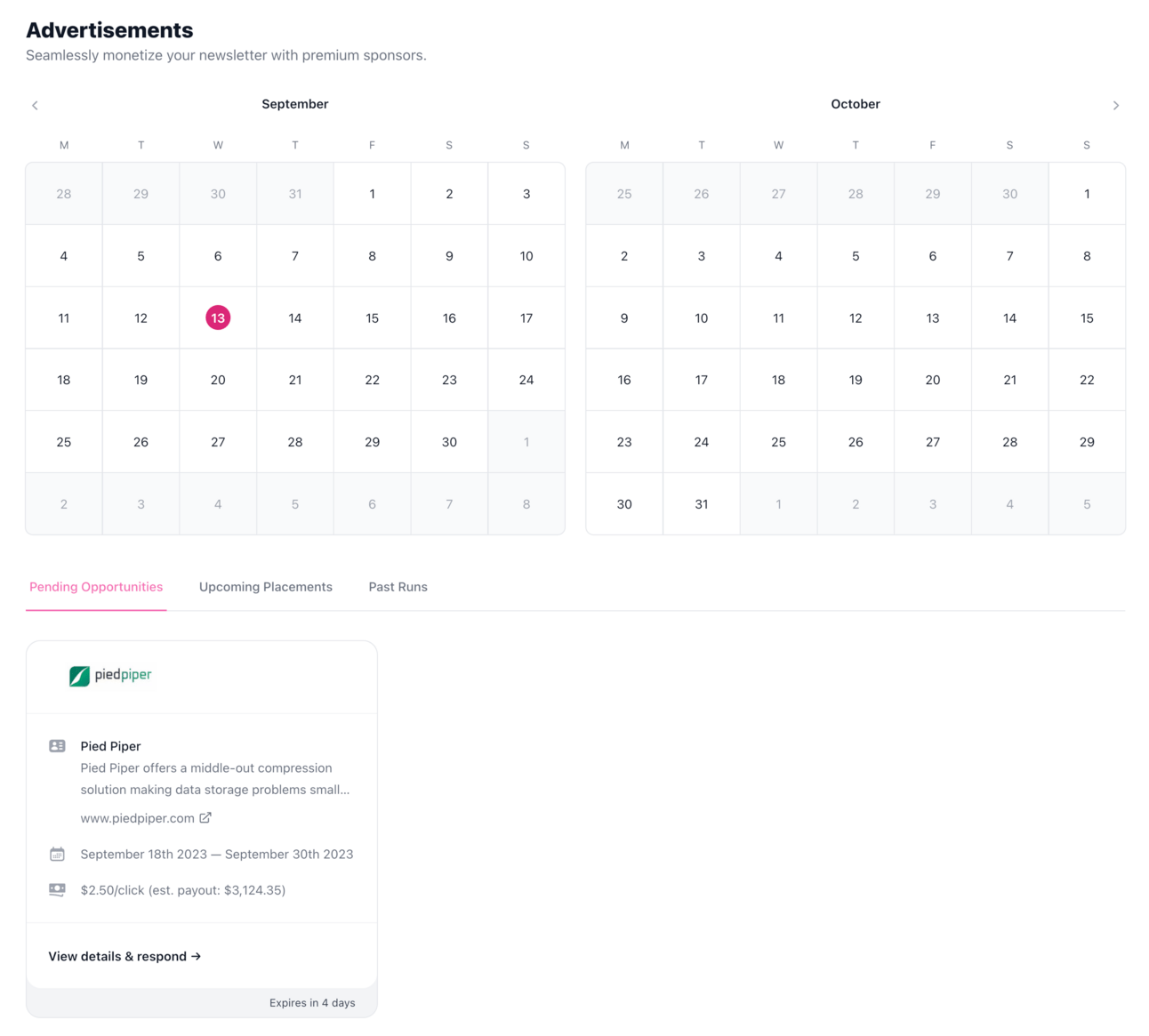
Look at the actual material.
Open the image for a closer view. Platform examples document the interface at the source date; they do not establish earnings or outcomes for this publication.
Sources & limits
No universal newsletter sponsorship price or conversion rate is asserted. Platform fees, payment processing, tax treatment, and subscription rules require a fresh jurisdiction-specific check before launch.
Adapted from supplied research. See the evidence and review method. Section source notes identify supporting references; operational suggestions remain editorial judgment.
- How much does Substack cost?
First-party product documentation · Source updated 16 December 2025 · Primary source checked · 15 September 2026 - Are there any transaction fees?
First-party product documentation · Publication date not stated · Primary source checked · 15 September 2026
Source claims and editorial judgments remain separate. Send a correction with the passage and supporting evidence.