Open the visual model ↗
Separate attendee, sponsor, and cash ledgers
Ticket buyers purchase attendance or learning. Sponsors purchase defined visibility, access, or association. Keep their revenue and obligations separate even when both fund the same event. The cash ledger separately records deposit dates, payment fees, tax, sponsor collection, vendor due dates, refunds, and reserves. Gross bookings cannot pay a venue deposit if the cash has not arrived.
Choose a capacity that respects venue or platform limits, staff coverage, speaker format, and accessible delivery. W3C's event-accessibility guidance asks organizers to consider accessible venues and remote platforms, participant requirements, captioners or interpreters, sound, schedules, and accessible materials. Put those items in scope and budget before tickets open rather than treating them as late exceptions.
Source notes: Making Events Accessible
Calculate break-even from contribution per occupied seat
List fixed costs that do not change with attendance and variable cost per attendee. Deduct ticket-specific payment cost and variable fulfillment from the net ticket amount. Sponsor cash may cover fixed cost only after sponsor fulfillment and sales costs are deducted. Complimentary, staff, speaker, accessibility-support, and held seats consume capacity even when they generate no ticket revenue.
Hypothetical example: fixed event costs are $8,400. A sponsor pays $3,000, with $500 of sponsor sales and fulfillment cost, leaving $2,500 net sponsor contribution. The remaining fixed cost is $5,900. A $120 ticket has $20 variable cost and $5 modeled payment/refund provision, leaving $95 contribution. Break-even is 63 paid seats because $5,900 ÷ $95 is 62.1 and partial seats cannot be sold.
| Line | Amount | Treatment | Risk check |
|---|---|---|---|
| Fixed event cost | $8,400 | Cost before seats | Which commitments are non-refundable? |
| Sponsor revenue | $3,000 | Separate revenue | Has cash been collected? |
| Sponsor fulfillment | $500 | Deduct from sponsor revenue | Is delivery capacity reserved? |
| Ticket price | $120 | Gross per paid seat | Tax and fees defined? |
| Variable ticket cost | $25 | Deduct per paid attendee | Refund provision included? |
| Break-even paid seats | 63 | $5,900 ÷ $95, rounded up | Fits saleable capacity? |
All figures are hypothetical US-dollar planning inputs, not event benchmarks.
Reconcile physical capacity to saleable seats
Start with safe venue or platform capacity, then subtract speaker, staff, production, sponsor, complimentary, accessible companion, interpreter or captioner, and contingency allocations as applicable. The remaining number is saleable capacity. If the break-even paid-seat count exceeds saleable capacity, the event is structurally underfunded at the modeled price and sponsor contribution.
Use scenario rows for minimum, expected, and sold-out attendance. Variable cost should move with attendance while fixed commitments stay fixed. For hybrid events, budget the online and in-room experience as two connected delivery systems, including moderation and accessible materials.
Source notes: Making Events Accessible
Budget the cancellation path before committing cash
Record each vendor deposit, due date, refundability, substitution right, and cancellation trigger. Hold a customer-refund reserve based on the written policy and applicable obligations. Model full cancellation, postponement, speaker loss, venue failure, and a low-sales stop date. A postponement is not free: staff time, supplier changes, sponsor remedies, and ticket-holder choices still have costs.
Do not use unearned sponsor or ticket cash for unrelated spending while cancellation exposure remains. At the go/no-go date, compare collected unrestricted cash with unavoidable delivery and refund commitments, not just booked revenue. Escalate if a sponsor promise or ticket policy conflicts with the practical remedy available.
Close the event after every obligation clears
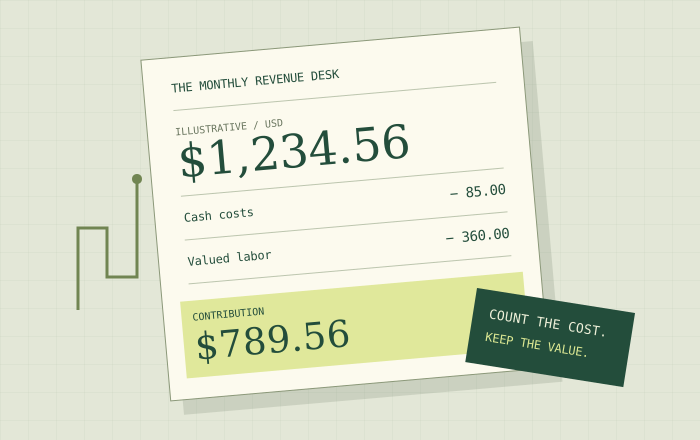
Reconcile paid, complimentary, refunded, disputed, no-show, and attended seats. Reconcile sponsor delivery and any remedy separately. Accrue invoices not yet received, record staff hours, and keep recording, transcript, caption, or follow-up obligations open until delivered. Contribution is collected revenue minus event-specific cash cost and valued labor under the stated accounting view.
Compare the result with the minimum, expected, and sold-out cases to improve the next budget. Do not convert one event into a universal attendance or pricing benchmark. The useful evidence is which assumptions changed and whether the event met its attendee, accessibility, sponsor, and contribution commitments.
- Calculate saleable seats after all operational allocations.
- Net sponsor revenue of its own sales and fulfillment cost.
- Keep a dated cash-commitment and cancellation schedule.
- Close tickets, sponsors, accessibility deliverables, and vendor bills separately.
Source notes: Making Events Accessible
Continue the work
Sources & limits
The budget and figures are hypothetical editorial planning tools. Accessibility needs, contracts, tax, safety, cancellation, refunds, and venue obligations require event- and jurisdiction-specific review.
- Making Events Accessible
Primary source · Source updated 31 August 2022 · Primary source checked · 19 September 2026
Source claims and editorial judgments remain separate. Send a correction with the passage and supporting evidence.