
Open the visual model ↗
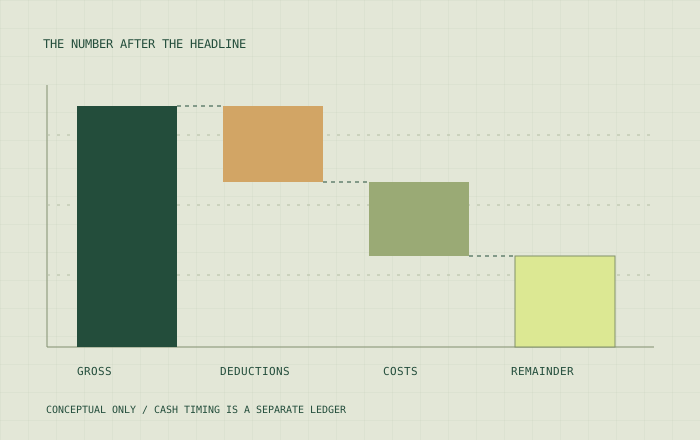
Traffic is several steps away from revenue
A pageview is a page load. A session groups activity by a visitor under an analytics rule. A planned ad opportunity is a slot the layout could request. An eligible request remains after consent, geography, policy, blockers, and technical rules. A filled impression records an ad served; a viewable impression applies a separate visibility standard. Publishers should never substitute one of these quantities for another in a model.
The useful chain is pages or sessions, opportunities per page, eligible-request rate, fill rate, paid impressions, price per thousand, publisher share, adjustments, and cash received. Page RPM divides publisher revenue by pageviews; session RPM divides by sessions. They can both be correct and still look very different. A direct campaign priced on guaranteed impressions, a programmatic eCPM, and a newsletter CPM also use different inventory and should stay separate in the ledger.
| Unit | Calculation | Question to answer |
|---|---|---|
| Fill rate | Filled impressions ÷ eligible requests | Were blocked or ineligible requests removed first? |
| eCPM | Revenue ÷ paid impressions × 1,000 | Is revenue gross to the intermediary or net to the publisher? |
| Page RPM | Publisher revenue ÷ pageviews × 1,000 | Which revenue lines and pageviews share the same period? |
| Contribution | Collected or accrued publisher revenue − named variable costs − valued labor | Is this a cash view or an accrual view? |
Choose one period, currency, and revenue basis before comparing alternatives.
Source notes: Publisher revenue evidence map, September 2026
Separate gross yield, contribution, and cash
Gross dashboard revenue is not profit. Add consent tooling, ad server or vendor fees, sales commission, creative work, implementation, monitoring, reconciliation, bank charges, refunds, makegoods, and the opportunity cost of slower pages or lost subscriptions. Value internal labor even when no invoice is paid. That turns a seemingly free revenue stream into a comparable operating choice.
Cash timing is a separate dimension. AdSense finalizes a month's estimated earnings early in the next month and, if the account passes its threshold and has no hold, issues payment around the 21st through 26th. Raptive states net 45. Direct advertisers may pay a deposit, net 30 after delivery, or later if procurement is slow. A December impression can therefore appear as estimated revenue, finalized revenue, an invoice, and bank cash on different dates. Keep those dates in different columns.
Source notes: Payment timelines for AdSense · Getting Started with Raptive · Display ad networks research brief
Run an inventory pilot with stop rules
Start with a bounded group of pages or a defined share of eligible inventory. Record a pre-test baseline for page speed, engagement, complaints, newsletter conversion, and revenue. During the test, reconcile provider reporting to your own page and request counts without expecting them to match exactly; document time zones, invalid-traffic adjustments, consent exclusions, and reporting latency that explain differences.
Define the decision before viewing the result. Continue only if collected or reliably accrued contribution clears the operating burden and the reader-experience guardrails. Revise if good yield comes with excessive density, layout shift, consent failure, or sponsor conflict. Stop if the provider requires a prohibited dependency, cannot explain material discrepancies, or creates concentration the business cannot tolerate. The purpose of the pilot is to learn the local economics, not to prove that a network category is good or bad.
- Snapshot the exact public terms and contract version.
- Name every denominator, time zone, currency, and revenue basis.
- Record staff hours and one-off setup separately from recurring work.
- Reconcile estimated, finalized, invoiced, and collected amounts.
- Review reader and performance effects beside revenue.
- Keep direct-sold, house, affiliate, and network inventory in separate rows before calculating a blended result.
- Record the counterfactual for unsold inventory: no ad, house promotion, another partner, or a direct campaign with its own sales cost.
- Delay a final judgment until invalid-traffic adjustments and the normal payment cycle have had time to appear.
- Annotate material reporting gaps instead of filling them with zero; an unavailable consent count or viewability measure is an unknown, not evidence that nothing happened.
Source notes: Publisher revenue evidence map, September 2026 · Display ad networks research brief
Sources & limits
The ledger defines a method, not a benchmark. Fill, price, eligibility, performance cost, and labor must be measured for the publisher's own inventory.
Adapted from supplied research. See the evidence and review method. Section source notes identify supporting references; operational suggestions remain editorial judgment.
- Payment timelines for AdSense
First-party product documentation · Publication date not stated · Primary source checked · 15 September 2026 - Getting Started with Raptive
First-party product documentation · Publication date not stated · Primary source checked · 15 September 2026 - Publisher revenue evidence map, September 2026
Supplied research brief · Retained in the private archive · Independent verification pending · Imported 15 September 2026 - Display ad networks research brief
Supplied research brief · Retained in the private archive · Independent verification pending · Imported 15 September 2026
Source claims and editorial judgments remain separate. Send a correction with the passage and supporting evidence.