
Open the visual model ↗
Start with eligible inventory
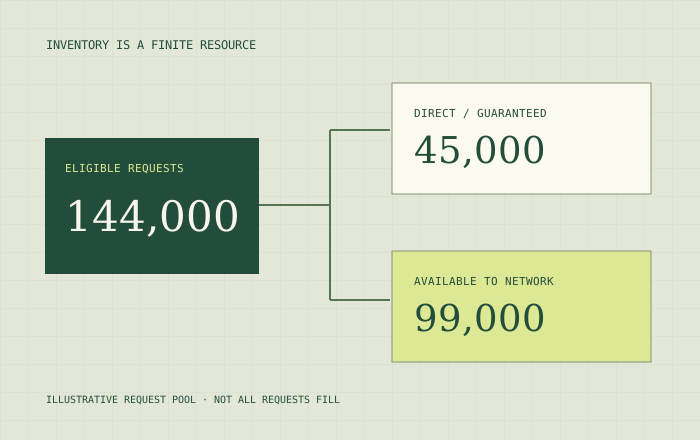
This one-month site model is illustrative, with invented CPMs and no claim about a real network. Assume 120,000 pageviews and 1.6 planned ad opportunities per pageview: 192,000 planned requests. If 75% remain eligible after consent, blockers, policy, and layout, the usable pool is 144,000 requests.
A direct campaign reserves 45,000 qualifying impressions at an invented $18 CPM, or $810 gross. The remaining 99,000 eligible requests are available to a network. At an invented 55% fill rate and $4.50 gross clearing CPM, that creates 54,450 filled impressions and $245.03 before the network share. A 75% publisher share leaves $183.77.
Revenue is not the final line
Total publisher revenue is $993.77. Now subtract a 10% sales commission on direct revenue ($81), $120 of ad-tech and measurement cash cost, and 12 operations hours valued at $50 ($600). The modeled contribution is $192.77, a 19.40% contribution margin. The labor valuation makes visible work that a gross-revenue screen can hide.
These calculations do not model tax, fixed overhead, refunds, bad debt, page-performance effects, or any change in reader trust. They also do not establish that inventory will be eligible, sold, filled, or paid at the assumed terms.
- Direct gross: 45,000 ÷ 1,000 × $18 = $810.00.
- Network net: 54,450 ÷ 1,000 × $4.50 × 75% = $183.77.
- Contribution: $993.77 − $81 − $120 − $600 = $192.77.
Compare the direct layer with its alternative
With the same 144,000 eligible requests, a network-only counterfactual yields $267.30 before the $120 tech cost, or $147.30 after it. Against that baseline, the direct layer adds only $45.47 of modeled monthly contribution after its commission and labor. That does not prove direct selling is a mistake; a renewal or a more efficient sales process could change the result.
The judgment is that hybrid inventory should be treated as a testable operating design, not a default monetization stack. Define priority rules, consent-aware fallback, delivery counts, and makegoods before promising a placement. A share-of-voice goal also needs careful language: it is not automatically a guaranteed impression total.
Sources & limits
Every input is hypothetical; network eligibility, fill, clearing price, revenue share, and direct sales performance require dated evidence before use.
- About line items
First-party product documentation · Publication date not stated · Referenced in the earlier research pass · 15 September 2026 - Sponsorship line items
First-party product documentation · Publication date not stated · Referenced in the earlier research pass · 15 September 2026
Source claims and editorial judgments remain separate. Send a correction with the passage and supporting evidence.