
Open the visual model ↗
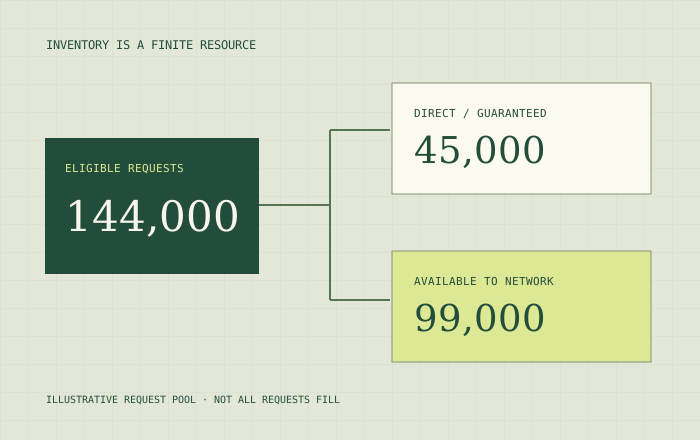
Define an eligible refresh as a new, bounded opportunity
A refresh replaces an ad in a slot without a full page navigation. The policy should say which trigger permits that replacement: a reader action, a meaningful content event, or elapsed time under stated conditions. Time alone is a weak description. Add whether the tab must be active, the slot must be in view, the page must still contain the same article, and the reader must not have paused or reduced motion or data where the product offers those controls.
Write exclusions first. Examples include audio or video that would restart, sticky units that obscure reading, checkout or account pages, pages for children, consent states that disallow the relevant processing, and any placement whose refresh would move content. The policy is a product rule shared by revenue, editorial, privacy, and engineering. A buyer-platform declaration can communicate inventory characteristics, but it does not implement these reader protections on the page.
| Control | Example rule | Evidence |
|---|---|---|
| Trigger | Meaningful reader action plus elapsed time | Event and monotonic clock |
| Attention | Active tab and visible slot | Visibility state and viewability event |
| Content | Same stable article state | Page/content identifier |
| Stop | Cap reached or reader inactive | Per-page refresh count |
Example rules require product review and platform-specific implementation.
Source notes: Declare refresh inventory · OpenRTB signaling ad refreshes
Count original and refreshed opportunities separately
Assign an opportunity sequence to each slot: zero for the original request, then one, two, and so on for refreshes. Preserve the page-view and slot identifiers. Report eligible opportunities, attempted refreshes, ad-server requests, filled impressions, viewable impressions under the chosen standard, and revenue by sequence. Do not add refreshed impressions to a page-view metric and present the result as if reach increased.
The denominator should travel with every rate. Refresh fill is filled refreshed requests divided by refreshed requests; revenue per page view includes all revenue divided by eligible page views; refreshed viewability uses measurable refreshed impressions. Also show the share of pages and readers that were eligible. A rule that acts on 8% of long-reading sessions cannot be evaluated from an all-site average alone.
| Measure | Original | Refresh 1 | Refresh 2+ |
|---|---|---|---|
| Requests | 100,000 | 24,000 | 7,000 |
| Filled impressions | 82,000 | 18,000 | 4,550 |
| Revenue | $410 | $81 | $18 |
| Revenue/request | $0.00410 | $0.00338 | $0.00257 |
Hypothetical values show separate populations, not expected performance.
Make stop conditions part of the reader contract
Set a per-slot and per-page cap, a minimum time policy, and an inactivity stop. Require the slot to reserve its dimensions so a new creative does not shift text. Stop refreshing after an error, a consent change, a page becoming hidden, or a creative that remains unmeasurable. If the publisher offers a pause control, it should stop future opportunities rather than merely hide animation while requests continue.
Review the policy on mobile with slow connections and assistive technology. A refresh that steals focus, repeats an announcement, resets reading position, or loads a heavier asset creates costs that revenue reporting will miss. Record complaints and page-performance measures beside monetization. The appropriate rule can differ by template and placement; document the reason rather than using one site-wide interval by convenience.
- Reserve slot space before the first request.
- Keep focus and reading position stable.
- Stop on hidden tabs, consent changes, and policy caps.
- Test screen-reader announcements and keyboard navigation.
- Expose original and refreshed inventory in buyer-facing declarations as required by the chosen platform.
Source notes: Declare refresh inventory
Approve the policy, then review the smallest rollout
Create a change card with eligible templates, slots, triggers, caps, declarations, report fields, owners, and rollback conditions. Start with a bounded placement only after engineering and commercial systems agree on the same definition. Compare against a stable control population when feasible. No single increase in impressions establishes reader or revenue benefit.
Review revenue per eligible page view, session depth, latency, layout stability, complaints, fill, and viewability together. Preserve the pre-change declaration and configuration. If a vendor report cannot separate refresh sequence, treat that as a measurement gap. Refresh is defensible when the policy is legible, the inventory is signaled accurately, and the publisher can stop it quickly.
Source notes: OpenRTB signaling ad refreshes
Continue the work
Sources & limits
Platform declarations and market expectations change. Confirm current contract and platform requirements before enabling refresh.
- Declare refresh inventory
Google Ad Manager documentation · Publication date not stated · Primary source checked · 19 September 2026 - OpenRTB signaling ad refreshes
IAB Tech Lab documentation · Publication date not stated · Primary source checked · 19 September 2026
Source claims and editorial judgments remain separate. Send a correction with the passage and supporting evidence.