The revenue mechanism
The Topics API is one piece of Google's Privacy Sandbox meant to let advertisers target ads by inferred interest without a shared cross-site identifier. Google's own developer guide, describing the mechanism as retrieved on 16 September 2026, explains that the browser itself, not an outside server, works out which broad interest categories, drawn from a fixed public taxonomy, a person's recent browsing fits into. A calling site can request this using a header on a fetch call or an attribute on an iframe, and the browser returns 'a maximum of three topics... one or zero for each of the last three weeks', limited to topics the calling site itself previously observed for that browser. Chrome's own feature tracker, Chrome Platform Status, records that the API shipped to desktop and Android Chrome at milestone 115, and Chrome's own milestone-schedule data lists 18 July 2023 as that milestone's stable release date.
What the documents show
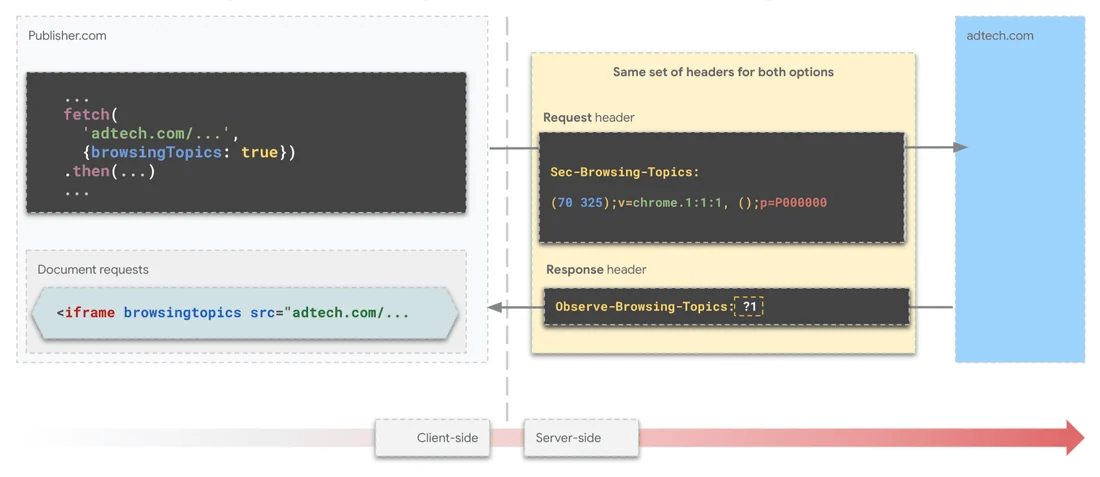
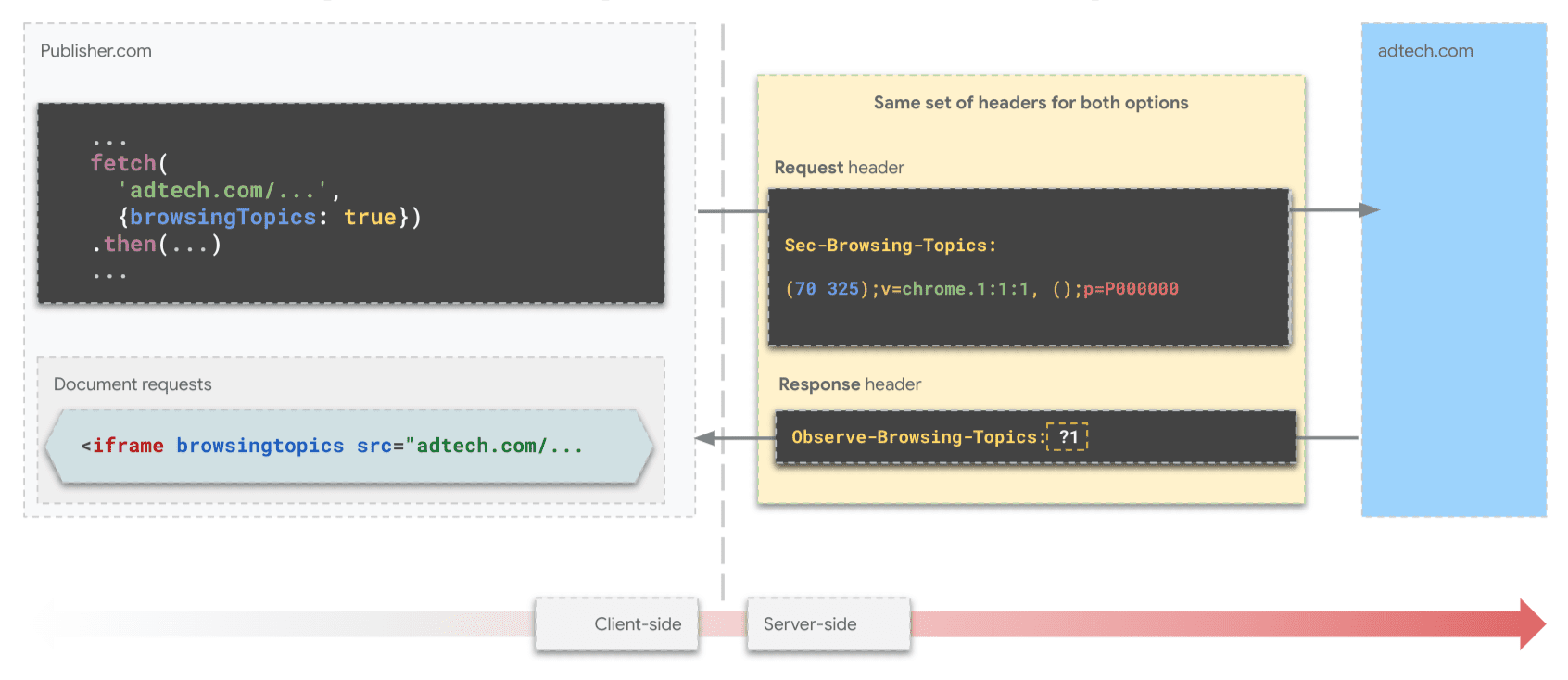
The developer guide is explicit that the mechanism is capped, not comprehensive: three topics, one per week, drawn from a taxonomy the browser vendor defines, visible to a site only if that site was already present when the topic was calculated. That is narrower than the profile-building third-party cookies allowed, where a network could accumulate an open-ended history across every site it was embedded on. The guide also documents the mechanics a publisher's page must implement: a browsingTopics fetch option or a browsingtopics iframe attribute to request topics, and an Observe-Browsing-Topics response header to register a topic as observed going forward. Neither Google source states a general-availability date in prose; that fact comes only from Chrome's separate milestone-schedule record, a different kind of document from the feature description itself.
The assumptions exposed
The design assumes three coarse, rotating topics are enough signal for relevant ad targeting to remain viable without a persistent identifier; whether that holds for any publisher's ad revenue is not something Google's documentation measures or claims. The taxonomy is fixed by Google and updated on its own schedule, so a publisher's category assignment can shift for reasons outside the publisher's control. It is worth separating what is audited from what is described: the shipped-milestone record is a verifiable engineering fact, but a claim that Topics-based targeting performs comparably to cookie-based targeting is not something this documentation states or supports.
What to check before you rely on it
A publisher relying on Topics-based demand should check current Chrome adoption, since desktop and Android availability is not the same as universal reach across every browser and platform. This is an editorial checklist, not a guarantee from Google.
- Does my ad partner's stack actually call the Topics API today, or is support still planned?
- Which taxonomy version is currently live, and has a category relevant to my content recently changed?
- Am I comparing Topics-based fill or rates against a documented baseline, or an assumed one?
The technical ceiling of three weekly topics is a documented constraint, not a marketing figure, and it is the right starting point for judging what this mechanism can plausibly replace.
Sources & reading trail
Describes how the Topics API calculates, caps and shares topics, and the implementation steps a site must take, as a living developer document.
Source published: Not established · Retrieved: 16 September 2026
Google's own Chrome feature tracker records the Topics API shipping to desktop and Android Chrome starting at milestone 115.
Source published: Not established · Retrieved: 16 September 2026
Google's own Chromium release-schedule data records 18 July 2023 as the stable release date for Chrome milestone 115.
Source published: Not established · Retrieved: 16 September 2026
Programme terms, standards and reports establish the entry; the assumptions reading is Publisher Revenue Guide editorial analysis. This retrospective draft does not imply the site published on the event date.